Can Electric Cars Drive Through Floodwater? EV Flood Safety Tips
1 OCTOBER 2026
Driving an EV Through Floodwater: How to Stay Safe
During the rainy season, heavy rainfall and flooding can make everyday driving more challenging, especially in urban areas. For EV owners, common questions include: “Can electric cars drive through floodwater?” “How deep is too deep?” and “What should I check after driving through water?”
BYD NOVA has put together some essential safety tips to help EV drivers assess flood conditions, reduce risks, and travel more safely during heavy rain and flooding.
Can Electric Cars Drive Through Floodwater?
Electric vehicles are designed with protective measures for high-voltage electrical systems and batteries against environmental exposure within specified limits. However, this does not mean that an EV can safely drive through floodwater at any depth.
Water levels can rise quickly, currents may be stronger than they appear, and flooded roads can hide potholes, open drains, debris, or other hazards.
If you cannot confidently determine the water depth or road conditions, avoiding the flooded route and choosing an alternative route is the safer option.
What Water Level Should EV Drivers Be Careful About?
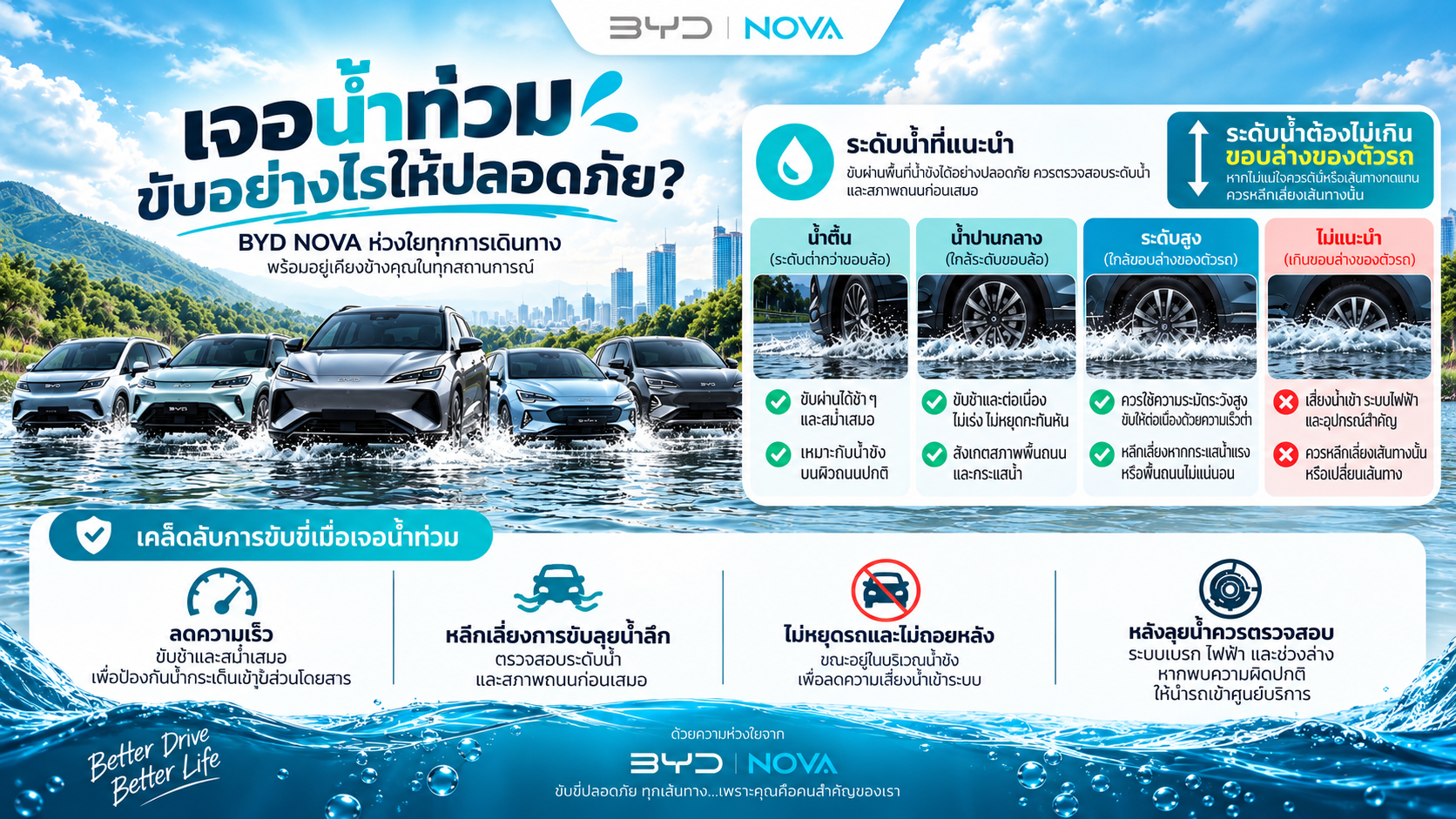
Before driving through standing water, assess the water level in relation to your vehicle and always refer to the owner’s manual for your specific model, as ground clearance and manufacturer recommendations can vary.
As a general guide:
- Shallow water below the wheel rim: If road conditions and water flow appear safe, drive slowly and maintain a steady speed.
- Water approaching the wheel rim: Use extra caution, reduce your speed, and leave more distance from the vehicle ahead.
- Higher water levels: The risk to the vehicle and your ability to maintain control increases significantly. Consider avoiding the route.
- Water reaching the vehicle’s underbody or higher: Do not attempt to drive through. Choose another route or wait for the water level to decrease.
The wheel rim should not be treated as a guaranteed wading-depth specification for every BYD model. Always follow the recommendations in the owner’s manual for your specific vehicle.
To make this easier to picture, the following figures can serve as a rough guide.
• Water below the bottom edge of the wheel, roughly under 15 cm — generally passable at low speed
• Water no higher than half the wheel, roughly 30–40 cm — pass slowly and steadily, and never stop in it
• Water above half the wheel — do not force your way through; change route immediately
These figures apply to still water only. If the water is flowing or other vehicles are creating waves, the safe level drops considerably — around 30 cm of fast-moving water is enough to float a car.
Do IP67 and IP68 mean the car can simply drive through water?
No. Both are dust and water ingress ratings for the battery pack and electrical system, tested in a laboratory under clearly defined conditions, such as immersion in still water at a set depth for a set time.
A BYD executive has stated publicly that the IP67 and IP68 ratings exist to protect the vehicle in an emergency, not as approval to deliberately drive through deep water.
The reason matters: most flood danger does not come from the battery, but from what you cannot see under the surface — open manholes, deep potholes, debris, or a current stronger than it looks.
Why doesn't an EV stall in water the way a petrol car does?
A combustion engine has to draw in air to burn fuel, and water entering the intake causes hydrolock, damaging the engine instantly. An electric car has no intake or exhaust system, and its motor runs inside a sealed unit, so that particular risk does not exist.
That does not make it safer in every respect. The cabin, carpets, seats, brakes, wheel bearings and low-mounted control units can be damaged in an EV exactly as they can in a petrol car.
4 Safety Tips for Driving an EV Through Flooded Roads
1. Reduce Your Speed and Keep It Steady
Avoid sudden acceleration. Driving too quickly can create larger waves and increase the possibility of water reaching sensitive areas of the vehicle.
If your car has already been flooded, see the detailed steps in our article Your EV Has Been Flooded — What Now? 6 Steps and the Things You Must Not Do, covering the immediate don'ts, arranging a flatbed, and the insurance claim.
2. Avoid Deep Water and Strong Currents
If you cannot see the road surface, do not know the actual water depth, or notice a strong current, avoid driving through the area. Do not assume a route is safe simply because another vehicle has made it through.
3. Avoid Stopping or Reversing in Floodwater When You Can Safely Continue
If conditions remain safe, maintain a slow and steady speed until you have cleared the flooded area. If conditions become unsafe, prioritize the safety of all occupants and follow instructions from local authorities.
4. Check Your Vehicle After Driving Through Water
Once you reach a safe and dry area, carefully check braking performance and watch for warning lights or unusual vehicle behavior. If the vehicle has passed through high water or shows any abnormalities, contact a service center for inspection.
What Should You Do If Your EV Is Flooded or Submerged?
If your EV has been exposed to high floodwater or partially submerged, do not attempt to restart the vehicle, continue driving, or handle high-voltage electrical components yourself.
Some types of water-related damage may not be visible from the outside. Contact roadside assistance or an authorized service center and have qualified technicians inspect the vehicle before using it again.
What Should You Check After Driving Through Floodwater?
Even if your EV appears to operate normally, it is a good idea to check or monitor the braking system, suspension, wheels and tires, warning indicators, and electrical systems after driving through flooded areas.
Pay attention to unusual sounds, warning lights, odors, or changes in vehicle behavior. If anything seems abnormal, stop using the vehicle when it is safe to do so and contact a service center for professional assistance.
Flooded Road Ahead? Avoid Taking Unnecessary Risks
Whether you drive an EV, plug-in hybrid, or conventional vehicle, avoiding flooded roads when the water depth and road conditions are unknown remains one of the safest choices.
Before traveling during periods of heavy rain, check weather and road conditions whenever possible. If you encounter flooding, assess the situation carefully before proceeding. When in doubt, choosing an alternative route can help protect both you and your vehicle.
BYD NOVA cares about every journey and is ready to be by your side wherever the road takes you.
Better Drive, Better Life
Found the BYD model for you? Book a test drive today
The BYD NOVA team is ready to advise you and arrange a free test drive at any branch
Book Test Drive